How LinguaMama Got Built, Part 1: Everyone Else Left
I spent the pandemic watching everyone on YouTube move to Thailand and Portugal. Then something shifted. Part 1 of the LinguaMama origin story.
By Geordie Everitt
The Schengen Shuffle sounds like a line dance at a retirement party in Cancún. It isn't. It's what you do when you discover that Americans can only stay in the European Union for 90 days out of every 180 — and instead of treating that as a hard stop, you treat it as a scheduling puzzle.
You spend three months in Portugal. Then you hop to Georgia — the country, not the state — or Montenegro, or Turkey, or anywhere outside the zone. Wait out the clock. Come back. Repeat.
I learned this from YouTube. Specifically from the forty-seven channels — give or take — dedicated to helping Americans figure out how to stop being Americans, at least geographically.
The Algorithm's Hypothesis
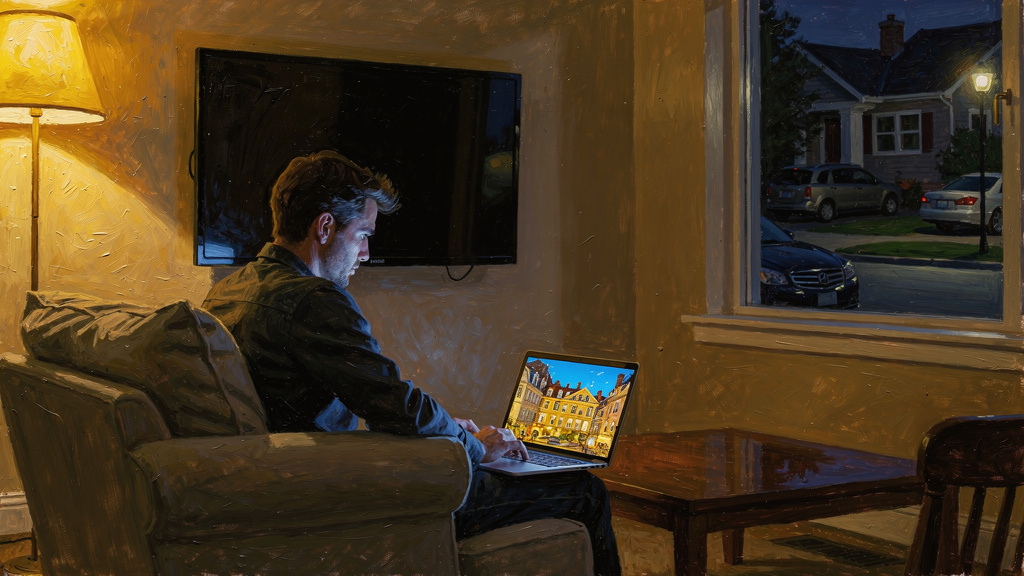
It started during the pandemic — not as an obsession, more as a diversion. Like watching glass-blowing videos or Gen-Z kids reacting to Rush. The algorithm served up expat content and I watched it the way you watch anything mildly interesting that requires nothing of you.
The expat YouTube world turns out to be a fairly distinct ecosystem. There are the adventure seekers — young, restless, making it all look effortless on a budget that doesn't fully add up. There are the retirees doing slow travel, renting furnished apartments for a month at a time, marveling at what €900 gets you in Porto versus what it gets you in Sarasota. There are the ones who'll say plainly, in that careful way people have when they're leaving something behind, that America had become difficult to watch — and that distance helped. And there are the Instagram entrepreneurs, nominally sharing their passion for travel while building relocation consulting practices and affiliate link portfolios.
Running alongside all of them, occasionally intersecting, was a different genre entirely: the polyglots.
These are people who speak five or eight or eleven languages with apparent ease, and whose content consists largely of deploying this ability on unsuspecting strangers. The formula is consistent: walk into a Chinatown, a Moroccan restaurant, a Korean grocery, and start speaking to the staff in their first language. Watch their faces change. Film the reaction. The shock is always genuine — a person who looks like a tourist addressing you in perfect Cantonese is, it turns out, still surprising in the twenty-first century.
I watched these too. With a slightly different feeling.
I have French ancestry — my family traces back to Quebec and further, and my parents actually met in France. I have good friends and colleagues who are Francophone Canadians. French was the language I had been quietly gesturing toward my whole life without actually getting anywhere near it. In the early days of podcasting I halfheartedly listened to some French language content for a while. It didn't stick. I had never taken a class.
That last part, I would later discover, was the luckiest thing about my language-learning history. But we'll get to that.
I watched all of them — the retirees, the escapers, the polyglots — with the detached curiosity of a man who had no particular plans.
Context: How I Got Here
I was born in Milwaukee in 1965. My father always had a job but never had a career, which meant we moved when opportunities required it. First grade at Holy Spirit School in San Antonio, living at the Del Coronado apartments across from the field — the one with the abandoned refrigerators, back when early-seventies America still offered children that particular kind of invitation. There was a pool. That's where I learned to swim.
Second grade covered Dallas, Houston, and Pinellas Park, in that order. Three schools, one year.
We landed in the Tampa Bay area in 1972 and I have lived in Pinellas and Hillsborough County more or less continuously for the fifty years since. I'm not entirely sure what to make of that. A childhood spent moving, and then just — stopping. It could have been a lot worse.
The Gulf Coast has its charms. I know where the good beaches are. I know which stretches of highway to avoid on a Friday afternoon in February when the snowbirds are headed to their cars.
I didn't get a passport until my thirties. Most of the overseas travel that followed was for work — consulting takes you places, though rarely the places you'd pick yourself. I tried to make the best of wherever I landed. Some of those places were genuinely interesting. Johannesburg. Sydney. Hong Kong. And, on one memorable occasion, the Mobile-Pascagoula Metropolitan Area.
But I had never seriously entertained the idea of actually living somewhere other than where I'd already been living. The question had never really formed as a question.
November 6th, 2024
Something happened on November 6th, 2024.
If you need me to explain what, you can probably stop reading here — this series will make more sense to people who already know.
The videos I'd been half-watching for years hadn't changed. The retirees were still touring their Porto apartments. The Schengen shufflers were still mapping their 90-day windows. The polyglots were still walking into Chinatown and delighting strangers. None of that was different.
I was watching differently.
The question — the one that had never really formed as a question — was forming.
There were obvious reasons I might stay. My mother is 87 and lives in Pinellas Park. My kids are grown but they grew up on St. Pete Beach, and they're still there. I'd been in the same two counties for fifty years.
But my brother Alex — who spent 25 years satisfying his wanderlust in Michigan and Colorado — recently came back. He lives now in the ancestral family mansion: a 1300 square foot cinder block home across from The Catholic, which is what our Baptist neighbors always called Sacred Heart Church and School. It's where I went to elementary school, where my mother taught for years, where she still attends, and where she has a scholarship named after her and a social network dense enough that I'm fairly certain she knows everyone within a three-mile radius by first name.
Alex is home. My mother is, by any reasonable measure, covered.
My partner Maria had always assumed I would be the one with reasons not to go. We call each other novelty-seeking robots, but she had the actual track record — years in Portland with her ex before the pollen evicted her. I was the Florida fixture. The one with roots.
On the evening of November 6th, 2024, I was the one who said: "Why don't we move somewhere?"
She was surprised.
She probably shouldn't have been.
Part 2: Where, exactly? And what do you do about the language?